
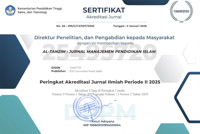







Al-Tanzim: Jurnal Manajemen Pendidikan Islam acknowledges that the rise of generative artificial intelligence (GenAI) tools and advanced language models presents unparalleled opportunities to improve scholarly communication, while also introducing new risks to research integrity, transparency, and accountability. Drawing from the STM Association’s 2023 White Paper on Generative AI in Scholarly Communications and the Committee on Publication Ethics (COPE) Position Statement on Authorship and AI Tools, Al-Tanzim establishes a comprehensive policy for the use of GenAI in all stages of manuscript preparation, peer review, editorial decision-making, and post-publication activities. This policy ensures that the benefits of AI, such as improved efficiency in language enhancement and data synthesis, are harnessed in ways that uphold the highest standards of scholarly rigor, ethical responsibility, and intellectual ownership.
Acceptable AI Use and Responsibilities for Authors
Authors submitting to Al-Tanzim may use GenAI tools for basic language and formatting tasks such as grammar correction, style consistency, and reference formatting without explicit disclosure, provided such use does not alter the intellectual content or conceptual contributions of the work. However, any significant use of GenAI that shapes the research narrative, generates new textual passages, performs data analysis, creates figures, or influences the study’s conceptualization must be clearly disclosed. These disclosures should appear in a dedicated “AI Contributions” subsection within the Methods or Acknowledgments, specifying the tool, version, provider, and the exact nature of its input and output. GenAI systems cannot be credited as authors, as they lack legal personhood and the ethical capacity to take responsibility for scholarly claims. Human authors are fully responsible for all content, including AI-assisted elements, and must ensure the accuracy, originality, and proper citation of AI-generated content.
Editorial and Peer Review Protocols
Strict ethical guidelines also bind editorial staff and peer reviewers to maintain confidentiality and uphold the integrity of the review process. Al-Tanzim prohibits the use of public GenAI platforms for plagiarism detection, confidentiality checks, or automated decision-making due to the opaque nature of their training data and uncertain data retention policies. Editors may use specialized, publisher-approved AI services under formal contracts, ensuring proper safeguards for manuscript confidentiality, intellectual property, and data security. All final editorial decisions must be based on human judgment, with AI outputs serving as an informational tool rather than replacing the expertise of editors or reviewers. Reviewers are explicitly prohibited from uploading unpublished manuscripts to public AI platforms or using such platforms to generate reports in order to preserve the integrity and confidentiality of the review process. If a reviewer suspects undisclosed substantial AI use by authors, they must report their concerns to the handling editor, following COPE’s guidelines on suspected AI misuse in peer review.
Scholarly Transparency
Al-Tanzim urges readers and the broader academic community to respect the boundaries of GenAI usage. Readers are discouraged from submitting full-text Al-Tanzim articles to public AI models to protect authors' intellectual property and maintain the confidentiality of unpublished data. Published articles that include substantial AI-assisted contributions will carry a footnote clearly indicating the extent of AI involvement, allowing readers to evaluate the source and reliability of the findings.
Future Revisions
Compliance with this policy will be monitored through periodic audits of published content, and COPE’s flowcharts will be implemented to address any ethical violations. Instances of undisclosed or inappropriate AI use may trigger Al-Tanzim's misconduct procedures, which may include corrections, retractions, or other remedial actions. Given the rapid development of GenAI technologies, Al-Tanzim will review and update this policy biennially or in response to significant technological or ethical advancements. With these measures, Al-Tanzim reaffirms its commitment to promoting innovation while maintaining the core values of transparency, accountability, and scholarly excellence.
